Powder actuated tool is a special direct fastening device. Firstly, it fires the cartridges to burn the gunpowder. Then it will generate high-pressure gas. Finally, PAT tools use these power to push the nails or drive pins to complete the fastening operation. So we need to use them together with powder loads and fasteners.
They have wide applications in construction and building decoration or interior finishing. Usually we use powder actuated nail gun to fix fasteners into concrete, steel and brickwork. It does not require external energy, such as compressed air, electricity, gas, etc. So PAT tools are convenient for on-site and high-altitude operations.
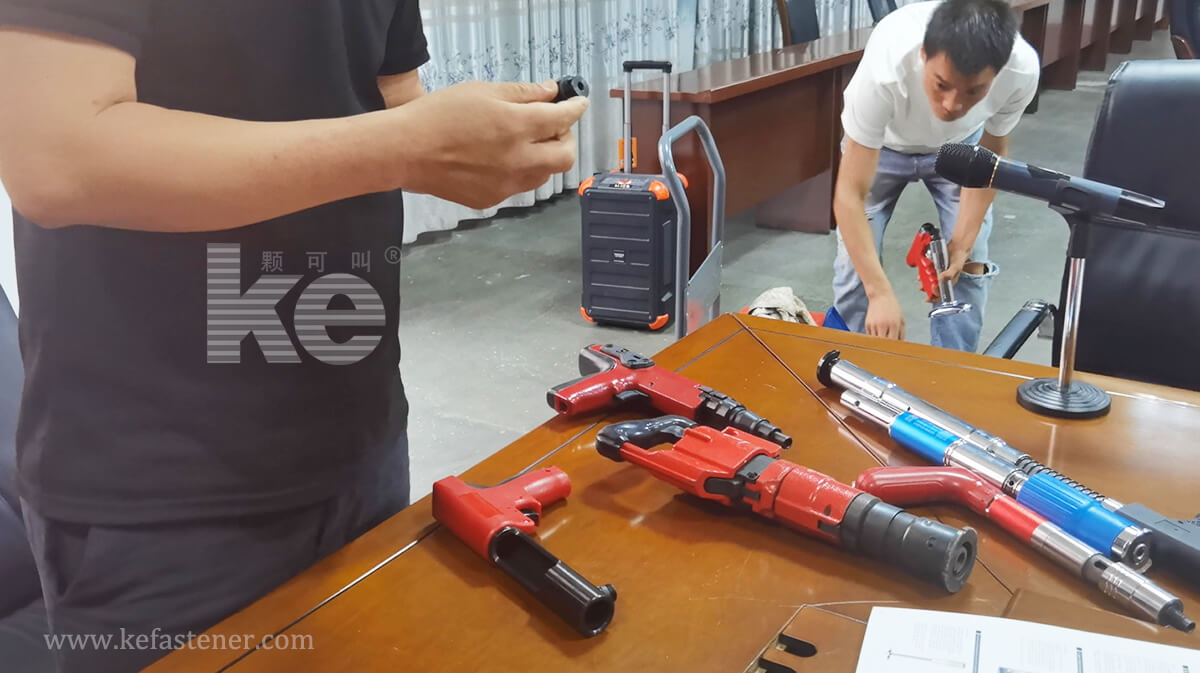
Types of powder actuated tools:
We can classify powder-actuated nail guns from three aspects. For example, the gunpowder nail gun includes different working principles, velocity and structures.
1. Direct-acting vs indirect-acting nail gun
The former uses high-pressure gunpowder gas directly on the nail. Finally, the power pushes the nail into motion. As a result, the nail has a very high speed and kinetic energy as it leaves the nail tube. Its speed or velocity is approximately 150 m/s.
The latter is a different tool. The gunpowder gas does not act directly on the nails, but on the piston inside the nailer. It transfers energy to the nails through the piston. Therefore, the speed of the nail when leaving the nail tube is low.
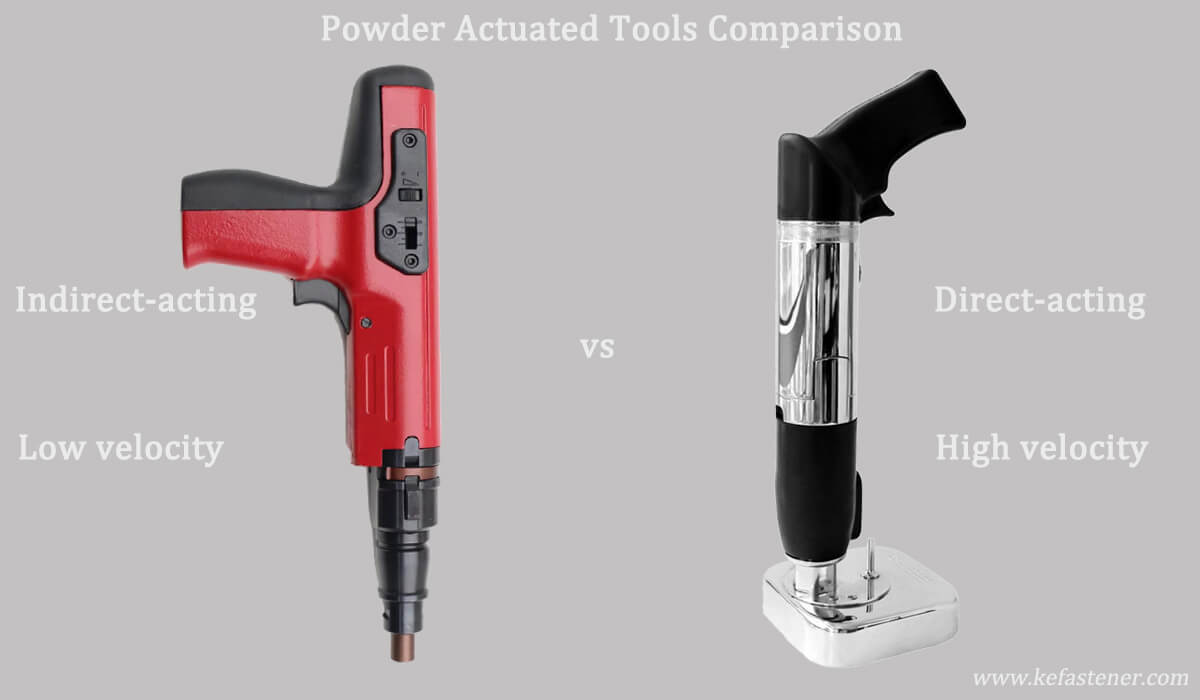
2. Low velocity vs high velocity PAT tool
Low velocity powder actuated tool: nail speed ≤ 100 m/s (suitable for lightweight materials);
Medium velocity powder nail gun: 100 m/s < nail speed ≤ 150 m/s (general construction installation);
High velocity tool: nail speed > 150 m/s (heavy steel structures);
In fact, the low velocity tools are also the indirect-acting nail guns. And the high velocity tools are also the direct acting powder actuated nail guns.
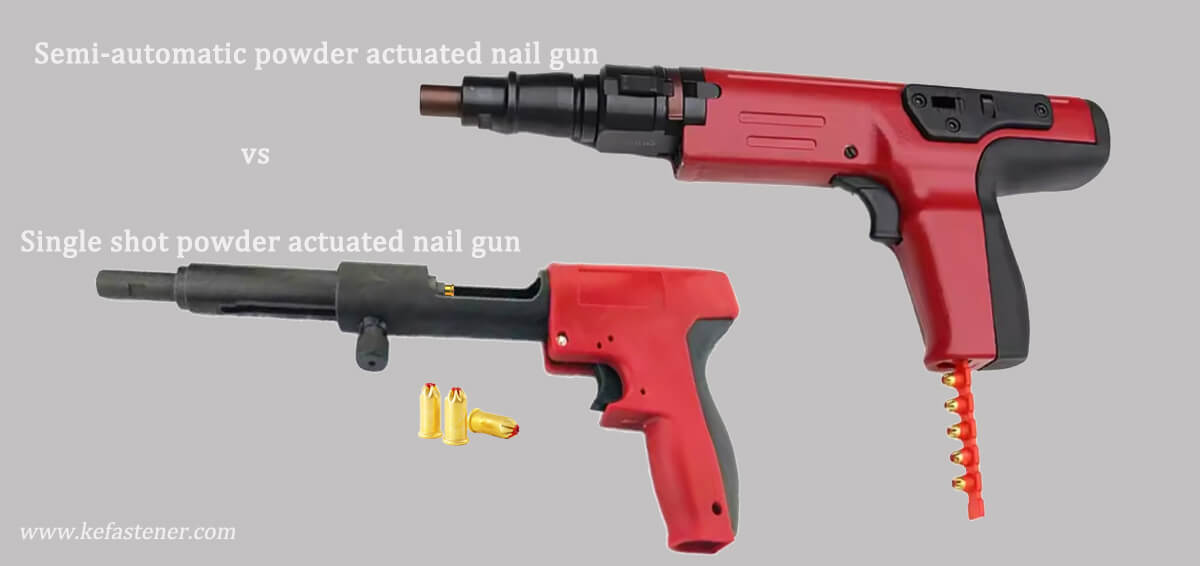
3. Single shot vs semi automatic strip loads tool
Our models JD307, JD307M, MC52, ZG103, ZG660 belong to the former type. The can’t reload the nails and powder boosters automatically.
But the semi automatic nail guns can load the strip loads. So it can automatically reload the cartridges. Compared to the former, it can reduce the operation time on jobsites.
Of course, both of them can’t reload the nails automatically. We have to reload the nails after each shot.
4. Semi automatic vs fully automatic nailer
Our JD301, JD301T, DP701, JD450 models are semi automatic powder actuated tool. They can load the powder boosters automatically. But there is no magazine. So the tools can’t load the drive pins automatically.
The fully automatic powder-actuated nailers are with magazine. So they can realize to load both the nails and the cartridges. For example, Hilti brand DX 5-SM, DX 6 MX models, Dewalt brand DFD270SK, DFD270MK models and Ramset brand RA27 model are all the fully automatic PAT tools. Compared to semi automatic tools, they can reduce the downtime on jobsites.
5. Traditional type vs new integrated type tool
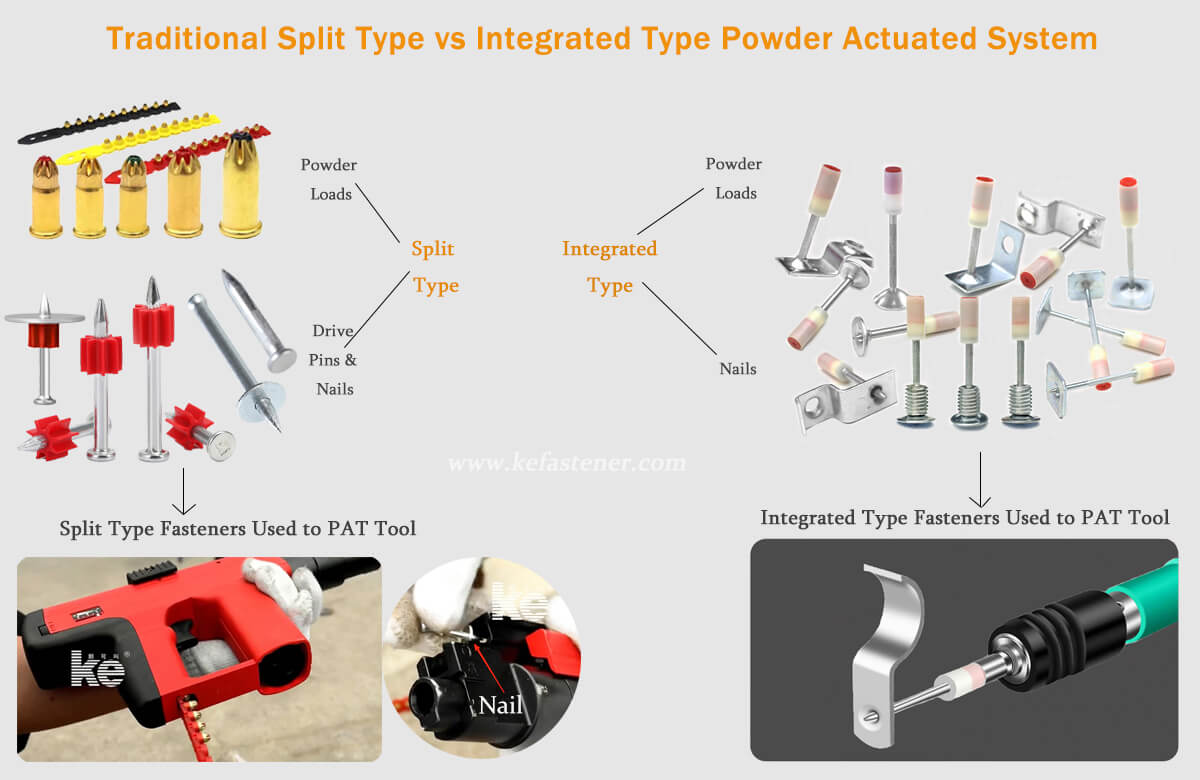
The types mentioned above are basically traditional powder actuated tools. They are used together with powder cartridges / bullets and drive pins. Usually, we put the drive pins into the muzzle of the gun barrel. Then we load the powder loads into the gun. There are two types: single shot and strip power loads. The most feature is that the cartridges and drive pins are separate.
But the integrate type PAT tool is different. It is suitable for the integrated powder actuated fasteners. The cartridges and nails are 2-in-1. Its structure is relatively less complicated. Therefore, the operation is more convenient and simple. Moreover, they are lighter in weight and cheaper in price than traditional tools.
The structure of gunpowder nail gun:
Because there are several models of powder actuated nailer, we take the most common JD301 and mini TZ models as examples to understand their structures. JD301 is the traditional PAT tool. And mini TZ is a new integrated type tool.
1. JD301T tool structure
Below is the part list of JD301T powder actuated fastening tool.
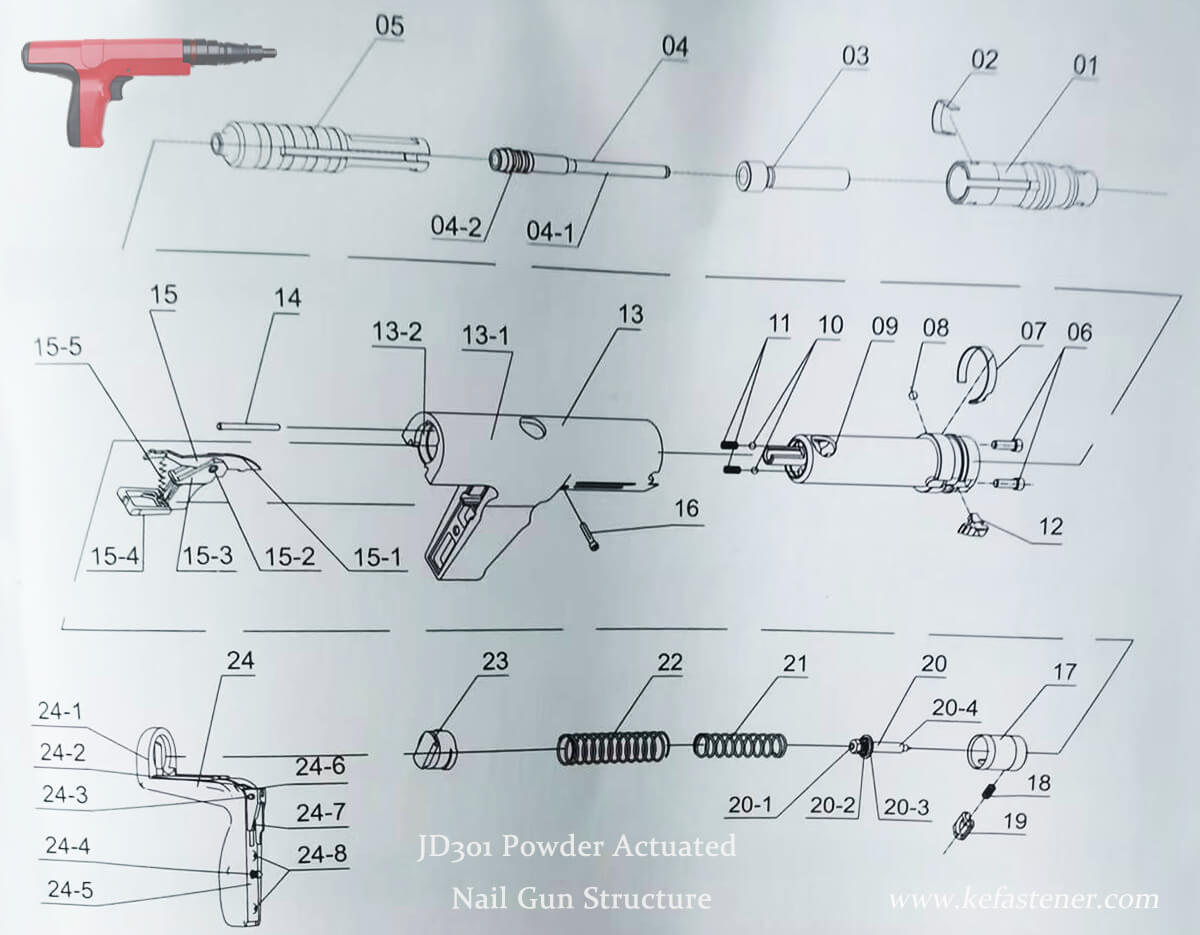
| No. | Part Name | No. | Part Name | No. | Part Name | No. | Part Name |
| 01 | Nail tube sleeve | 10 | Steel ball Φ5 | 15-4 | Lever seat | 21 | Firing pin spring |
| 02 | U-shaped circlip | 11 | Magazine ball spring | 15-5 | Lever tension spring | 22 | Stop frame return spring |
| 03 | Nail tube | 12 | Directional key | 16 | Fixing axis | 23 | Tail cover |
| 04 | Piston | 13 | Cassette | 17 | Stop frame | 24 | Grip assembly |
| 04-1 | Piston rod | 13-1 | Cassette body | 18 | Safety spring | 24-1 | Grip gasket |
| 04-2 | Piston ring | 13-2 | Open ring | 19 | Stop | 24-2 | Firing assembly |
| 05 | Firing tube | 14 | Knockout pin | 20 | Firing pin assembly | 24-3 | Pin 4*18 |
| 06 | Screws M6*8 | 15 | Trigger assembly | 20-1 | M6 high-strength nuts | 24-4, 24-8 | Screws M6*12, Screws M6*10 |
| 07 | Circular leaf spring | 15-1 | Spring feed lever | 20-2 | Inertia spring | 24-5 | Bracket body |
| 08 | Steel ball Φ6 | 15-2 | Hollow pin | 20-3 | Safety ring | 24-6 | Lever return spring |
| 09 | Frame | 15-3 | Trigger | 20-4 | Firing pin body | 24-7 | Trigger spring |
2. TZ model mini nailer structure
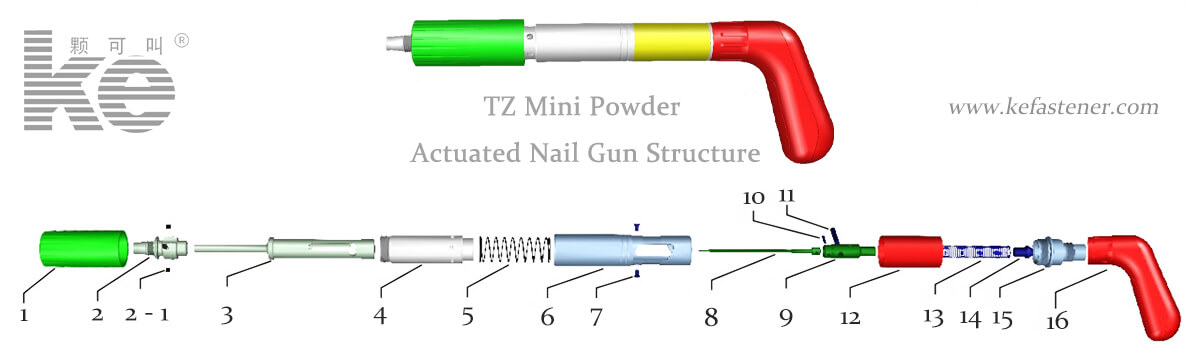
How do powder actuated tools work?
The PAT tool uses the high-pressure gas generated by firing blank cartridges as its power source. When the gunpowder is detonated, it will explode instantly in a confined space. The tremendous thrust will drive the nails in the tube into the concrete or steel plates. In fact, the working principles of traditional nail gun and new integrated nailer are similar. Let’s take an integrated mini nail gun as an example to explain how the tool works.
1. When no nails loading
Under the action of the firing spring, the firing pin sleeve and firing pin block components are forced toward the end of nail tube. However, the stop pin, acting as a stopper, prevents the main barrel from sliding into place. Simultaneously, the return spring forces the firing pin slide assembly and all components at the front of the movable barrel in opposite directions. At this time, the firing pin sleeve slide assembly slides toward the end of the nail tube.
At the same time, under the action of the brake pin spring, the brake pin continues to exert upward force. When the slide reaches the rear end of the firing slot, the second step of the brake pin pops out. At this time, the firing pin seat assembly and firing pin sleeve assembly are locked. Both mechanisms cannot move left or right. The firing mechanism is locked. All components of powder actuated tool are relatively relaxed.
2. When nailing and firing
Firstly, we load the PAT nails. When the nailer is pressed downward, all components on the movable sleeve move backward. They move to the nail position. At this time, the nail is subjected to force, and the firing pin sleeve assembly and all components of the movable sleeve move backward. At the same time, they compresses the firing spring. As the gun is pushed further toward the base, the inclined surface on the base presses down on the top step of the brake pin. The second step of the brake pin sinks. The third step is smaller in diameter than the firing slot. At this time, the firing pin base assembly separates from the sleeve assembly.
Compressed force of the firing spring is instantly released. So it pushes the firing pin assembly forward. The firing pin, guided by the sleeve, penetrates the nail cap. High-speed firing ignites the gunpowder, which explodes. The force of the gunpowder combustion and explosion pushes the plastic base and nail forward until the nail is seated in the base.
3. Remove the plastic shell of integrated nails
After driving the nails successfully, the plastic shell of the integrated nail separates from the steel nail. Most of the plastic shell will remain inside the nail barrel. At this time, the powder actuated tool mechanism is in its un-nailed state.
Repeat the firing action. The firing pin sleeve is inside the nail barrel. Firing spring prevents the firing pin sleeve and firing pin assembly from retracting. The plastic shell or debris inside the nail barrel provides little resistance. Repeat this action until the shell is ejected. We can repeat this process twice. It will ensure a smoother ejection of the nail barrel.
What’s the applications of powder actuated nail gun?
We usually use the PAT tools for construction and house renovation. They can drive nails directly into hard substrates and surfaces without external energy. These tools are suitable for fastening operations on substrates such as concrete, steel structures, brickwork, etc.. We can fix the components that need to be fixed, such as pipes, doors and windows, wood products, insulation boards, sound insulation layers, decorations, clips, ceiling components permanently or temporarily.
But powder actuated tools are not suitable for the porous, brittle and loose materials, such as hollow bricks, glass, tiles, drywall, gypsum board, etc. Because these materials may break, causing fasteners or substrates to fly. Eventually it may cause harm to the operator and surrounding people.
Below are some common applications:
(1) Steel-to-steel fastening applications: Fix various metal parts to steel sheets, plates or structures. For example, when we renovate floors and roofs, we can fix corrugated steel sheets onto the steel structure. Alternatively, we can also fasten some metal hangers to the steel frame.
(2) Wood-to-steel fastening applications: Attach some wood block or thick wood plate, such as 4mm thickness, onto the structural steel or steel beams. Of course, the wood materials should be not too thin. Otherwise, the powder actuated tool and nails will break the wood.
(3) Steel-to-concrete fastening applications: Fasten the steel components or frame onto the concrete walls or floors. For example, we often install light steel keels on the ceiling. Sometimes, we also need attach metal pendants onto the walls. If we need to fix the fire extinguisher onto the wall, it can use the PAT tools and fasteners.
(4) Wood-to-concrete fastening applications: Fix the wooden parts or frame onto the concrete walls or foundations. Likewise, the wood should be of a certain thickness and not too thin. For example, it can fasten the wood joist or keel onto the ceiling.
Of course, powder-actuated tools and fasteners have other applications. For example, attach the pipes, cables, and exhaust duct onto the walls or ceilings. They can also fasten some hard plastic components.
Why we need the powder actuated tools?
Besides gunpowder nail gun, there are several common nail guns on the market, such as pneumatic, electric and gas nail guns, etc. Each nailer has its advantages and disadvantages. So they have different specific application scenarios. Next, we will make a simple comparison between them.
1. Powder-actuated nail gun
• Source of power: utilize the gunpowder gas produced by firing cartridges as a driving force to fasten nails into the building.
• Features: gunpowder nail guns are powerful. They are suitable for the fixing of hard materials. These materials require deep high strength nail shooting. However, the risk of operation is high. So it must follow the strict safety practices. Avoid harm to personnel and the surrounding environment.
PAT tools have wide applications in construction industry. These nailers have high power level. They typically have a single shot power of a few hundred joules. Therefore, PAT nail guns can easily penetrate steel plates. Some can penetrate up to 10mm. And they can also easily ingest nails into C30 and C40 concrete. For concrete, the depth of penetration can be more than 30mm. And for brick masonry, the penetration depth can reach 30~50mm. Other nail guns can’t do this. Moreover, gunpowder nail guns have their own energy source. So it’s free from wires and air compressors. Easy to carry and work on site.
2. Pneumatic & electric nail guns
• Power source: they need external energy —— pressure energy of compressed air, electrical energy. The nail guns convert these energy into mechanical energy. Then shoot the nails out.
• Features: operation is relatively easy. Shooting nails is fast and efficient. They are suitable for occasions or jobsites where it requires continuous nail shooting.
Compared to powder actuated tools, they have a smaller power level. The power of a single shot is usually around a few dozen or a dozen joules. Dozens of nails can be loaded at a time. We mainly use them in carpentry construction. They have wide applications for wood and plastic, concrete, brick materials. But their penetration depth into concrete and brick is less than powder actuated tools.
3. Gas nail gun
• Power source: utilizing the heat and gas pressure generated by the combustion of gas as a driving force for shooting nails.
• Characteristics: shooting nails is strong. But the operation is relatively complicated. And need to ensure the safe use of gas. Avoid fire and explosion and other safety hazards.
Gas nail gun is mainly used for general renovation construction. For example, we can use it to fasten roofing, heat insulation, sound insulation, electrical & plumbing, doors and windows, cable tray and so on. Of course, it is also suitable for concrete. But it has a smaller power level than the PAT tool. Maximum of about 100 joules in a single shot. It can drive nails through 2mm steel sheet and then into low strength concrete.
The development history of powder-actuated nail gun and cartridges
It’s a nail gun-like tool used to fasten materials. Workers have applied them in building construction field for decades.
1. The earliest stage
In China, early powder nail guns were primarily used in steel mills. People used them to repair and secure steel molds and furnace materials. At that time, PAT tools had a limited application scope. With the development of repair technology, nail gun repair techniques have become obsolete.
At that time, the powder cartridges were powerful, dangerous, and generally ineffective. They were also cumbersome to use. These nail guns and the accompanying S2 powder loads have disappeared from the market. S2 powder cartridges are center firing.
2. The era of direct acting nail guns
As the name suggests, direct acting nail guns means that gunpowder gas pushes the nail directly. Finally, it completes the connection between the nail and the base material. A notable change of powder actuated tool during this period is as follows: it changed from center firing to rim firing. This change resulted in lower costs and reduced power. However, the guns still provided significant fastening power, capable of securing high-strength concrete, rock, thick steel, and other foundation materials.
However, in actual construction, they often produce excessive force, damaging both the nails and the base material. Ultimately it made the fastening ineffective. When used on fragile base materials, they can easily penetrate, causing nails to fly out and cause accidents. Therefore, nail guns of this period often had large safety shields on the nozzles. This type of nailer has been unable to overcome various drawbacks in construction, such as limited application scenarios, excessive power, high risk, and small available nails range. As a result, it has gradually been eliminated from the market.
3. Indirect acting powder actuated tool era
To solve the problem of excessive power of direct-acting nailers, indirect-acting nail guns were developed. Their key improvement is the addition of an indirect-drive piston between the cartridges and the nail. This further reduces the kinetic energy transferred to the nail. At the same time, the piston also reduces the speed of nail. Therefore, it improves the safety and reduces the kinetic energy of an uncontrolled nail ejection. This also prevents damage to both the nail and the base material.
Most pistons have the following design: a 16mm diameter head, a set of sealing rings, and an 8mm shank. The advent of indirect-action nail guns has expanded their application range, from industrial applications to construction and home decoration.
Here we introduce some models of the most common indirect action powder actuated tools in domestic construction.
(1) JD307 single shot nail gun
The 307 series is the most common nailer used in construction. It is a lightweight, single-shot nail gun. When using, it requires loading the cartridge and nails separately. After firing, pull the barrel forward to extract the cartridge. It uses the less powerful S5 series cartridge, which measures 5.6 x 16 mm.
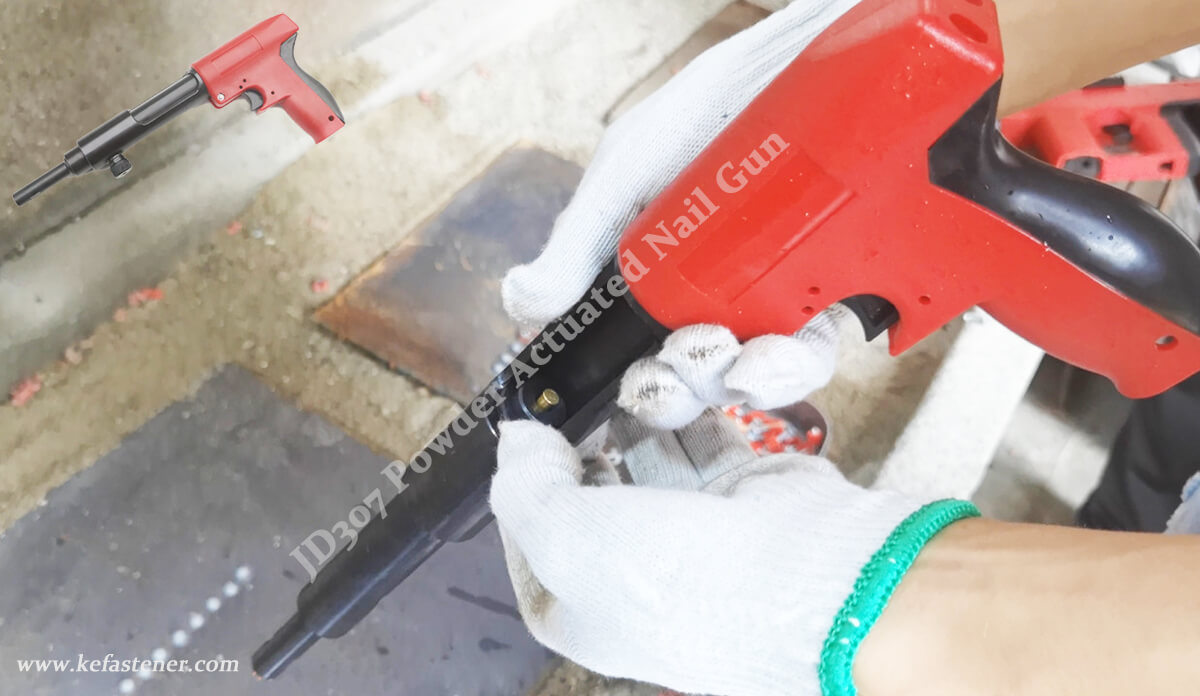
However, illegal and criminal activities to transform them into bullets often occur. As a result, the governmental authorities have issued regulatory measures to prohibit the sale of this nail cartridge in the Chinese market. This has resulted in a decline in sales of the 307 series nailer.
(2)603 series nailer
It is a heavy duty indirect action nail gun. It is rugged, quiet and comfortable in the hand. We can use it by changing different bullet feeders. Use two kinds of powder loads, S1 and S3. So it can meet different construction requirements.
(3)301 series powder actuated tool
The primary feature of the 301 series nailer is their use of a ten-round plastic strips for ammunition feeding. They can fire ten shots in succession. Therefore, it can save construction time and reduces labor requirements. In addition, the 301T model tool features a side-mounted power adjustment knob. So it supports stepless power regulation, adapting to various construction environments.
Of course, the 301 series nail gun also has the disadvantages. For example, it can only use the S1 model powder loads. Its size is .27 caliber 6.8*11mm. In certain construction scenarios, its power is insufficient. And the plastic strips are disposable. This will increase construction costs.
4.The era of integrated fastening nail gun
In fact, currently over 90% of the market share in China is held by this type of integrated tool. It is different from the above powder actuated tools. Its main feature is the integrated encapsulation process combining the drive pins and the powder cartridges. This enhances safety and prevents tampering. Key characteristics include simple operation and single-load functionality, eliminating the need for separate assembly.
Its principle is similar to that of a direct-acting nail gun. Gunpowder directly propels the nail for fastening. It can replace traditional nail guns in 90% of applications. The kinetic energy of nitrocellulose integrated nails is approximately 1100 joules. It can penetrate approximately 8mm ~ 10mm steel before driving into concrete.
Moreover, there are various types of integrated fasteners. They can accommodate diverse application scenarios. For instance, pipe clamp fasteners can directly secure pipes with diameters of 16mm, 20mm, 25mm, and 32mm.
The new type of nail guns offer numerous advantages, including lightness, ease of operation, and high safety. Furthermore, the nail penetration hole is shaped like a trumpet. It can deform to buffer and release excess kinetic energy. Thus it will prevent excessive power. In addition, many models offer adjustable power, increasing their adaptability to different base materials.
Common powder-actuated tool brands
This tool is quite special. It’s powered by gunpowder. Not many countries produce it. Common brands include the following companies:
1.Ke
• Factory place: Sichuan province, China;
• Establishment: December 2000 year;
• Employees: more than 200;
• Main products: nail guns, powder loads, drive pins and integrated nails;
Ke is the brand of Sichuan Ke Technology Co., Ltd. The factory is Sichuan Guangrong Fastening System Co., Ltd. And another brand “Kekejiao” is very famous in Chinese market. Our integrated nails occupies at least 50% of the Chinese market share. We are the biggest manufacturer of powder actuated fastening system in China. Now our factory mainly produce the new type of PAT tools for the integrated nails.
2.Hilti
• Country:Liechtenstein;
• Establishment time: 1941;
• Number of employees: about 34000;
• Business range: power tools, grinders, drills, , saws, fasteners, anchors;
Hilti is a leading global brand of high-end tools for the construction industry. It focuses on providing technologically advanced products and solutions for construction and industrial fields. In addition to single shot and semi-automatic nail guns, they also provide fully automatic powder actuated tool. But they don’t have the integrated type P.A.T. fasteners and tools.
3.Ramset
• Headquarters:United States;
• Foundation time: 1948;
• Employees: about 50,000 staff worldwide;
• Main products: gas nailers and powder actuated nail guns, fasteners, powder loads, accessories;
Ramset is a subsidiary of ITW Commercial Construction. It has a history of more than 70 years. Ramset is also a leading brand of direct fastening tools and fasteners. They main provide two types of tools. One is the gas nailers and the other is powder fastening tools. In the construction market (primarily focused on tools and fasteners), their revenue in 2017 was approximately $1.7 billion. Likewise, they don’t have the integrated type nails and tools.
4.Simpson Strong-Tie
• Headquarters: Oakland, California, USA;
• Establishment: year 1956;
• Employees: about 5000 staff globally;
• Main business: connectors, fasteners, anchors, structural steel and systems for construction industry;
The powder-actuated tool is just one of their many products. Their company has dealers in Asia, America and Oceania. They only have five models of PAT tools. One model is semi-automatic type. Two models are the single shot type. And the other two models are the hammer-drive tools. Simpson Strong-Tie don’t have fully automatic and integrate type PAT tools.
5. Nitroset
• Headquarters: Houston, TX USA;
• Foundation time: 2010 year;
• Employees: about 11-50 staff;
• Main products: solid powder propellant fastening tools and nails for concrete and structural steel;
Nitroset only provides the new innovative integrated solid propellant fastening tools and fasteners. There are two models of tools. Both of them are good choice for ceiling or overhead fastening applications. They don’t have the traditional PAT tools.
6.Dewalt
• Headquarters: Towson, Maryland, U.S.;
• Establishment: year 1922;
• Employees: over 10000 staff;
• Business range: power tools, hand tools, anchors, fasteners, direct fastening tools, etc;
Dewalt belongs to Stanley Black & Decker company. It is a high-end professional power tool brand. Their tools are widely used in construction, carpentry and other fields. There are 10 models of powder actuated tools, including fully automatic type. But they also don’t have the new solid propellant fastening tools.
7. BLUEPOINT FASTENERS
• Headquarters: Chino, CA, United States;
• Founded: 2012 year;
• Employees: less than 25 staff;
• Main products: powder actuated fasteners and tools;
It is a dynamic company which develops and sells construction fasteners, nailer tools, acoustic hanging systems, etc. Blue Point Fasteners is a leader of innovation fastening solutions to the North and South American construction markets.
8. MOLOT
• Headquarters: Moscow, Russia;
• Establishment: 2019 year;
• Employees: less than 10 staff;
• Business range: direct fastening system products for construction industry;
MOLOT is a trading and manufacturing company that supplies the Russian market with a wide range of construction tools and fasteners. They provide both traditional powder actuated tools and new type ceiling nail gun. In addition, MOLOT also supplies the gas-actuated nailer.
9. GEFEST
• Headquarters: Moscow, Russia;
• Establishment: year 2007;
• Employees: about 80 staff;
• Business range: direct fastening nail gun, fasteners and powder cartridges;
How to use powder actuated nail gun?
Here we take two nail guns as examples to illustrate how to use them. One is the traditional semi-automatic 301 nail gun. And the other is the NT2003 ceiling nail gun.
1. Use the 301 semi-automatic powder actuated tool
(1) Firstly, pull the nail barrel sleeve forward until it stops. This step is to reset the piston. Then push the nail barrel sleeve back into the original place.
(2)Secondly, put the drive pin into the nail barrel.
(3) Thirdly, insert the strip loads into the magazine slot at the bottom of the handle. Ensure that the bottom of the strip is flush with the bottom of the handle. If using a partially-fired strip loads, pull the strip upward to align the un-fired cartridge with the chamber.
(4) Hold the nail gun perpendicular to the base material and press it down into place. Then, pull the trigger. The cartridge fires, driving the nail into the base. Finally, release the nail gun. So it completes one fastening. Repeat steps 1 and 2 for the next fastening.
(5) If the power loads don’t fire after pulling the trigger, keep the nail gun compressed for at least 5 seconds before releasing it. Then compress the nail gun into place and pull the trigger. If it still doesn’t fire, pull the nail barrel forward until it’s in place and then back off to align the next nail cartridge with the chamber. Repeat step 5 to continue fastening work.
2. Use the NT2003 ceiling nail gun
(1) Firstly, pull the nail barrel forward to eject the debris and reset the nail gun.
(2) Secondly, install the extension rod to the powder actuated tool and tighten it.
(3) Thirdly, put the integrated fastener into the nail barrel . (The plastic shell faces inward and the nails face outward.)
(4) Perform this fastening work: adjust the extension rod to the appropriate height. Raise the extension rod so that the dust cover of the nail gun is against the ceiling working surface. Make sure the nailer tool is perpendicular to the ceiling. Then push the extension rod upward to complete the fastening operation. Finally, the steel nails will be automatically driven into the ceiling. Repeat steps 1 and 3 to start the next fastening.
3. 10 Rules for Safe Operation of Powder Nail Guns
These nail guns are special tools powered by gunpowder. So they have very high requirements for performance and safety. We must operate according to strict codes of conduct.
(1) Operators without professional training are not allowed to operate the powder actuated tools.
(2) Operators must wear the following protective measures: safety helmet, goggles, gloves, earplugs, etc.
(3) Never point the nail gun at others or yourself. Do not give the nailer to unauthorized persons to play with.
(4) During normal use, it is necessary to clean the internal parts in time and replace them when necessary.
(5) If a misfire occurs, be sure to point the nail barrel toward an open, unoccupied area. Then, lay the powder nail gun flat, or away from valuables. Use pliers to remove the nail by pointing vertically at the nail barrel opening. Operators are strictly prohibited from observing or repeatedly pressing the nail barrel opening.
(6) Don’t modify the tool structure for other purposes without authorization. Accessories must be original parts. Otherwise, it will affect the product function.
(7) After use, check whether there are any unfired nails in the nail gun. When not in operation, make sure there are no nails in the tool.
(8) When working, other people need to watch from 3 meters away. The viewing angle should be kept at least 30 degrees to the nailing area.
(9) During the operation, the verticality between the nailing port and the base surface is not less than 85 degrees.
(10) Do not work on porous, fragile, or loose substrates. For example, do not fasten hollow bricks, ceramic tiles, or ALC partition panels. During operation, ensure that no one or valuables opposite the nailing area. When nailing concrete, maintain a minimum distance of 10 cm from corners.
This article provides a detailed explanation of what a powder actuated tool is. If you want to buy powder-actuated nail gun, welcome to contact us.
Post time: Nov-02-2025